
Festival Season Marketing for D2C Brands in India: The Complete Performance Playbook

Updated: Aug 22
Every year, sometime in late September, something predictable happens to the D2C brands we work with: their Meta ad costs spike, their Google CPCs jump and founders start questioning whether the festive season is actually worth it.
They're not wrong to feel the pain. But most of them are solving the wrong problem — they're reacting to a cost environment they should have built against months earlier. We've helped dozens of D2C brands navigate India's festive calendar, and this guide is everything we've learned distilled into one place.
What you'll find here: why the festive season is a structurally different opportunity in India, which categories win the most, how to build your plan, the CPM problem and how to solve it, what to do with your website and social channels, a detailed Instagram content plan, and — critically — where you as a founder should be putting your attention. In short: D2C brands that start building warm audiences and owned channels (email, WhatsApp) in June–August pay 2–3x less to acquire customers during the October–November peak than brands that wait until the season starts.
Here is a comprehensive breakdown of the festive season marketing strategy, every D2C brand in India needs right now:
Key Festive Season Stats Every D2C Brand Should Know
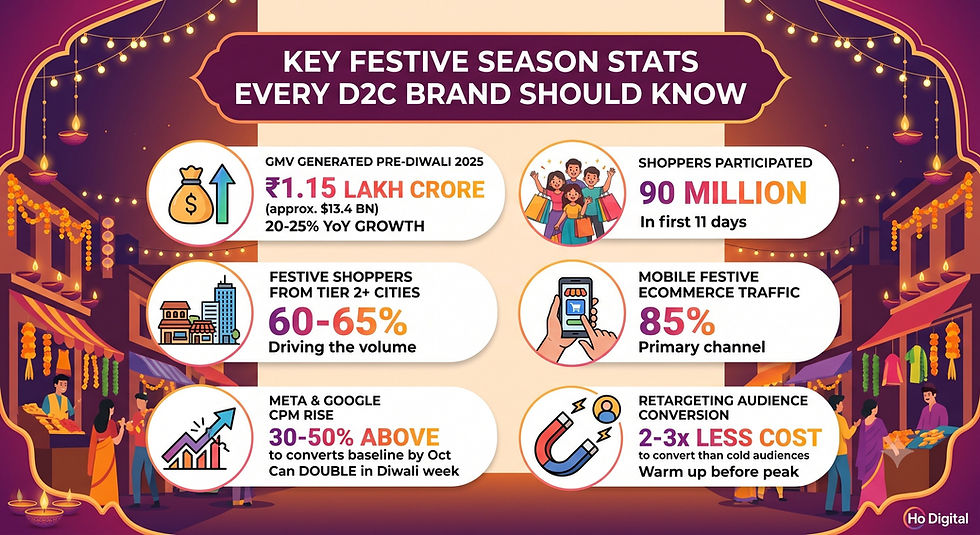
The 30–35-day pre-Diwali window in 2025 generated ₹1.15 lakh crore (~$13.4 billion) in GMV, growing 20–25% year-on-year (Redseer, 2025)
90 million shoppers participated in just the first 11 days of the Diwali 2025 sales window
60–65% of all festive shoppers in India now come from Tier 2+ cities
85% of festive ecommerce traffic in India happens on mobile devices
Meta and Google CPMs rise 30–50% above August baseline by October, and can double during Diwali week
A warm retargeting audience costs 2–3x less to convert than a cold audience during peak season
Brands with strong owned channels (email, WhatsApp) can reach their best customers during Diwali week at near-zero marginal cost
Why Festival Season Marketing in India Is Unlike Anything in the World
Most global markets get one Q4 peak — Black Friday, Christmas, done. India operates on a fundamentally different rhythm. The cultural calendar hands D2C brands over 20 purchase-intent windows across 12 months: Makar Sankranti in January, Holi in March, Eid in March, Raksha Bandhan in August, Navratri and Dussehra in October, Diwali in November, Christmas in December. Each festival carries its own emotional register, its own gifting culture, and its own high-intent product categories.
The scale is real. The 30–35 day window before Diwali 2025 alone crossed ₹1.15 lakh crore (~$13.4 billion) in GMV, growing 20–25% year-on-year — the strongest performance in five years (Redseer, 2025). About 90 million shoppers participated in just the first 11 days of that Diwali window, spending roughly ₹7,000 each on average.
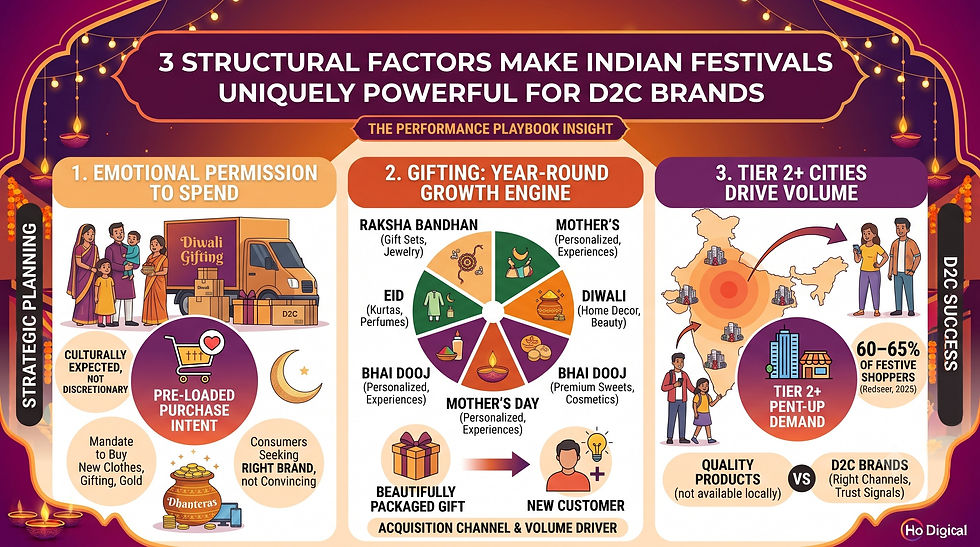
Three structural factors make Indian festivals uniquely powerful for D2C brands:
1. Emotional permission to spend. Festivals in India aren't just occasions — they're mandates. Buying new clothes for Diwali, gifting for Raksha Bandhan, buying gold on Dhanteras — this isn't discretionary spending, it's culturally expected. Purchase intent arrives pre-loaded. Consumers aren't waiting to be convinced to buy; they're looking for the right brand to buy from.
2. Gifting as a year-round growth engine. Unlike the West, where gifting concentrates around Christmas, Indian gifting is distributed across the calendar — Raksha Bandhan, Eid, Diwali, Bhai Dooj, Mother's Day. For D2C brands, gifting is both a volume driver and an acquisition channel: the person who receives a beautifully packaged gift from your brand is a potential new customer who's never heard of you before.
3. Tier 2+ cities now drive the volume. Tier 2+ cities account for 60–65% of festive shoppers in India today (Redseer, 2025). These consumers are online, mobile-first, and increasingly comfortable with D2C brands. They have pent-up demand for quality products that aren't available locally — which is exactly the gap D2C brands can fill if they show up with the right channels and the right trust signals.
The CPM Paradox: The Season Where Everything Gets Expensive at Once
Here's the truth every D2C brand learns the hard way: the festive season is when customer intent is highest AND when advertising costs are highest simultaneously.
By mid-September, Meta CPMs in India start climbing. By October, they're 30–50% above their August baseline. During Diwali week, some categories see CPMs double. Every brand — large and small, D2C and marketplace — floods into the same auction at the same time.
This is the CPM paradox: the season everyone needs to win is the season that's most expensive to compete in. Most brands respond by simply accepting higher CACs in October–November as the cost of doing business. The brands that win solve it differently — and they start in June.
How to Cope With Rising CPMs: The Three-Part Answer
Build warm audiences before the auction starts.
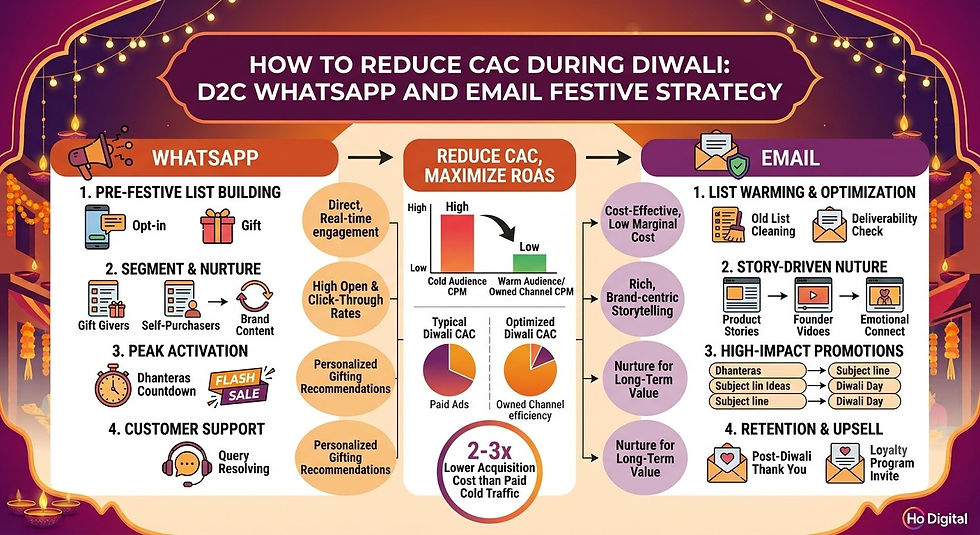
The most important lever against CPM inflation is audience temperature. A warm audience — someone who visited your site, engaged with your Instagram, or watched 50% of a Reel — costs 2–3x less to convert than a cold audience during peak. The economics of retargeting a warm audience at ₹40 CPM versus finding cold customers at ₹120 CPM, at scale, is the difference between a profitable Diwali and a breakeven one.
In practice: run awareness-only campaigns in July and August. Not conversion campaigns. Not discount-led creative. Pure brand content — product stories, founder videos, lifestyle content — with the sole objective of building the largest possible retargeting pool before September. When the CPM auction heats up, you're converting warm prospects.
Own channels that don't participate in the CPM auction.
Every email subscriber, WhatsApp contact, and push notification opt-in you hold is a customer you can reach during peak season without bidding against anyone. These are your most valuable festive assets — and they're built in the months before the season, not during it.
Email, WhatsApp, and app push notifications have near-zero marginal cost per send. If you have 50,000 email subscribers, you can activate them on Diwali day for the cost of your ESP subscription. No CPM. No competition. The brands that dominate festive revenue consistently are the ones with the largest owned-channel footprint.
Be surgical with paid spend during peak.
During Diwali week, don't try to do everything with paid ads. Use paid channels to retarget warm audiences and acquire lookalikes of your best existing customers. Use owned channels (email, WhatsApp, push) for everyone already in your ecosystem. Reserve deep discount campaigns for proven high-intent windows — Dhanteras, Diwali day, Black Friday — rather than running promotions across the entire season and eroding your margin.
Pre-Festive Preparation Timeline: What to Do Month by Month
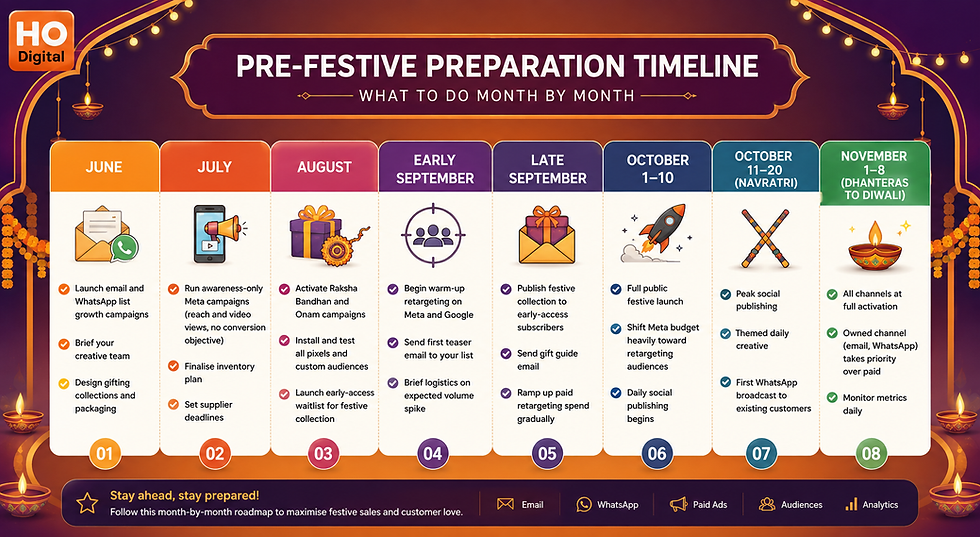
June: Launch email and WhatsApp list growth campaigns; brief your creative team; design gifting collections and packaging
July: Run awareness-only Meta campaigns (reach and video views, no conversion objective); finalise inventory plan; set supplier deadlines
August: Activate Raksha Bandhan and Onam campaigns; install and test all pixels and custom audiences; launch early-access waitlist for festive collection
Early September: Begin warm-up retargeting on Meta and Google; send first teaser email to your list; brief logistics on expected volume spike
Late September: Publish festive collection to early-access subscribers; send gift guide email; ramp up paid retargeting spend gradually
October 1–10: Full public festive launch; shift Meta budget heavily toward retargeting audiences; daily social publishing begins
October 11–20 (Navratri): Peak social publishing; themed daily creative; first WhatsApp broadcast to existing customers
November 1–8 (Dhanteras to Diwali): All channels at full activation; owned channel (email, WhatsApp) takes priority over paid; monitor metrics daily
Which D2C Categories Get Maximum Benefit from Festival Season Ads Campaign
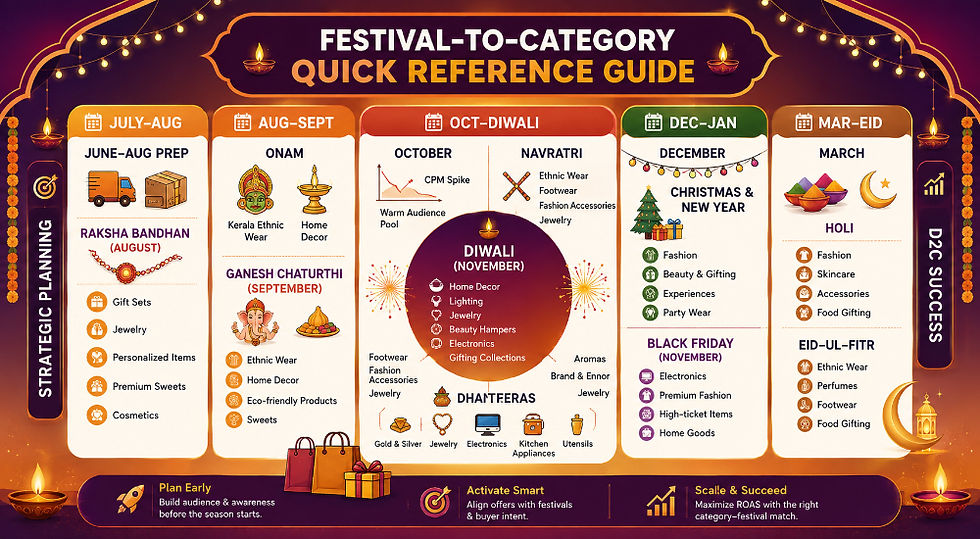
Not all categories lift equally. Understanding where your brand sits in the festive demand curve should shape how aggressively you invest — and what story you tell.
Festival-to-Category Quick Reference
Diwali (November): Home decor, lighting, jewelry, beauty hampers, electronics, gifting collections
Dhanteras (November): Gold and silver jewelry, electronics, kitchen appliances, utensils
Navratri (October): Ethnic wear (chaniya choli, lehenga), footwear, fashion accessories, jewelry
Raksha Bandhan (August): Gift sets, jewelry, personalized items, premium sweets, cosmetics
Holi (March): Fashion, skincare (pre-Holi protection + post-Holi recovery), accessories, food gifting
Eid-ul-Fitr (March): Ethnic wear (kurtas, sherwanis), perfumes, footwear, food gifting
Onam (August–September): Kerala ethnic wear, home decor, gold jewelry, traditional food
Ganesh Chaturthi (September): Ethnic wear, home decor, eco-friendly products, sweets
Black Friday (November): Electronics, premium fashion, high-ticket home goods
Christmas and New Year (December): Fashion, beauty gifting, experiences, party wear
Tier 1: Maximum Festive Lift
Fashion & Ethnic Wear is the single biggest festive category in India. Every festival generates new clothes demand. Navratri drives chaniya choli and lehenga searches. Diwali lifts all ethnic wear subcategories. Holi drives color-themed fashion. Eid is a major moment for kurtas, sherwanis, and occasion wear. If you're in fashion, the festive season isn't just an opportunity — it's a survival requirement for the year's revenue targets.
Jewelry & Accessories sees its two highest-conversion days of the year on Dhanteras and Diwali, driven by the cultural mandate to buy gold and silver on auspicious days. Raksha Bandhan creates sharp gifting demand for jewelry. The emotional purchase driver here is stronger than almost any other category — price elasticity shrinks significantly when the purchase carries cultural meaning. We've seen this play out directly running Meta ads for a stone jewelry brand during Dhanteras, where cultural timing outperformed discount-led messaging.
Home Decor & Lighting is Diwali season, full stop. Diyas, fairy lights, decorative items, cushion covers, wall art — all spike sharply in October–November. The Onam window also creates meaningful home decor demand in South India. Brands in this space often see their single highest revenue weeks of the year during Diwali. The same room-transformation with Google Ads we used for a home decor brand outside the festive season applies even more directly here — Diwali buyers need to see the item in a Diwali-decorated home, not on a white background.
Beauty & Personal Care is driven primarily by gifting. Cosmetics hampers, skincare gift sets, and fragrance collections are among the most popular Diwali and Raksha Bandhan gifts. Holi creates a specific beauty moment: pre-Holi protection and post-Holi recovery products see consistent demand spikes that well-positioned brands capture well.
Tier 2: Strong Category-Specific Lift
Food & Gourmet Gifting — Dry fruits, premium chocolates, artisanal sweets, and curated hampers. Corporate gifting alone runs to thousands of crores during Diwali. D2C food brands that build gifting collections rather than just selling individual products capture disproportionately large basket sizes. The key insight: position the gift set, not the product.
Electronics & Tech Accessories — Dhanteras is an auspicious day for electronics purchases. The broader Diwali window drives demand for laptops, headphones, smartwatches, and smart home devices. For D2C electronics brands competing against marketplace mega-sales, the play is differentiation through superior customer experience, not just price matching.
Kids & Toys — Children's Day (November 14) and the broader Diwali gifting period both create demand. Educational toys and premium toy brands see notable lifts. The gifting occasion drives higher willingness to pay than everyday purchases.
Fitness & Wellness — A growing festive category. The post-Diwali "new beginning" sentiment mirrors the January reset — consumers make lifestyle upgrade decisions in this window. Supplement brands, fitness equipment, and wellness products all see meaningful demand from late November onward.
Tier 3: Moderate Lift with Strong Niche Demand
Sustainable & Eco-Friendly Products — Growing year on year. Ganesh Chaturthi has created real demand for eco-friendly Ganesha idols and sustainable decor. Diwali creates demand for non-toxic diyas and sustainable gift packaging. Brands in this space that lean into the cultural moment connect with a value-aligned consumer segment that's both growing and underserved.
Pet Products — Nascent but notable. Diwali specifically creates demand for pet anxiety products during the crackers period. This is an example of a category that doesn't map to traditional festive gifting but has found a genuine purchase trigger within the season.
The Month-by-Month Festival Season Marketing Plan for D2C Brand in India
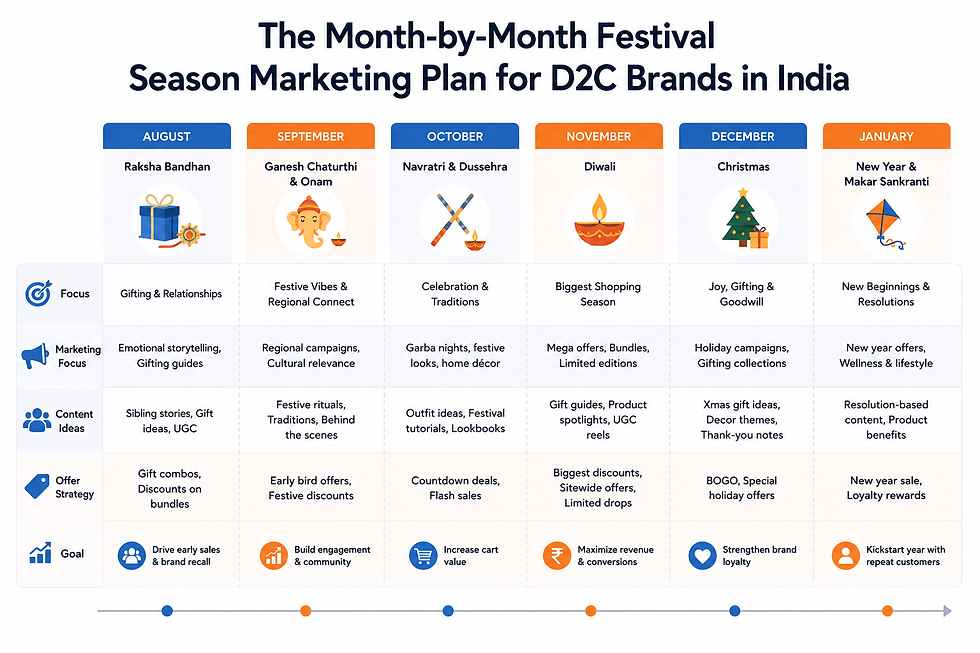
Phase 1: Foundation (June–July) — Build What Others Won't
This is when the season is built, not launched. The work you do here determines whether October is profitable or expensive.
Build your owned channels. Run paid acquisition campaigns with a primary goal of email and WhatsApp list growth, not immediate revenue. Offer lead magnets: early access to festive collections, exclusive gifts with first orders, a festive lookbook download. The cost per lead in June is a fraction of what it will be in October.
Produce your creative assets now. Lock festive campaign photography, video content, and design templates in July. Shooting under deadline pressure in October, when every production house is booked, is both more expensive and lower quality. Brands that enter October with a full creative library execute faster and at lower cost. Brands without in-house production capacity can get this built through a video creation and amplification service rather than scrambling for a production house in September.
Finalize inventory before your supplier does. Know your festive SKU list, planned stock levels, and supplier timelines by July. Stockouts during Diwali week are brand-damaging — you can't recover those customers, and negative reviews about availability compound long after the season ends.
Design your gifting collections. Gift boxes, hampers, bundles, and personalized message options need to be designed, sourced, and photographed. These decisions take weeks to implement from scratch. Starting in September is already too late for most product categories. Brands without a large pre-season budget to spend on awareness campaigns can still build a lot of this groundwork — here are some low-budget marketing tactics worth running in parallel.
Phase 2: Audience Building (August–September) — Fill the Funnel Before Costs Rise
Run warm-up content campaigns. Start publishing on Instagram, YouTube, and Meta with the explicit goal of generating engagement and website traffic — not conversions yet. Themes: festive preparation, gift guides, behind-the-scenes of your brand preparing for the season, product stories. The objective is being in your target audience's feed before every other brand enters in October.
Launch early access campaigns. Build a waitlist or early-access signup for your festive collection 6–8 weeks before launch. This converts a product launch into a demand event and pre-builds your highest-intent conversion audience before any spend goes into the peak window.
Capture Raksha Bandhan and Onam revenue. August brings two significant festivals that most brands underweight relative to their actual revenue potential. Raksha Bandhan (August 20, 2026) is one of the strongest gifting moments of the year — gift sets, jewelry, and personalized items all convert well. Onam (August 28–September 7, 2026) is South India's biggest harvest festival, a major occasion for ethnic wear, home decor, and food. Treat them as revenue windows in their own right, not as warm-up acts for Diwali.
Set up your tracking infrastructure. By September 1, every pixel, custom audience, and lookalike audience should be set up and accumulating data. The quality of your Meta and Google targeting in October depends entirely on the audience signals built in July and August.
Phase 3: Pre-Peak Activation (October 1–20: Navratri and Dussehra)
Launch festive collections publicly. Your early-access audience has already had a preview; now open to the world. Navratri (October 11–20, 2026) signals the cultural start of the festive season in the consumer mind, even if the spending peak comes later.
Shift paid spend toward retargeting. Now you're spending — but efficiently, against warm audiences built earlier. Meta campaigns should be heavily weighted toward website visitors, email list custom audiences, and engaged social followers from the past 90 days.
Email and WhatsApp activation begins. Send your first festive emails. Subject lines should telegraph the season clearly and specifically. WhatsApp broadcast messages work well here for existing customer relationships — position the message as a VIP early access, not a mass promotion.
Treat Dussehra as a conversion moment, not just a day. Dussehra (October 21) is an auspicious day for big-ticket purchases — electronics, home appliances, jewelry all see conversion lifts driven not just by discounts but by cultural timing. Messaging that acknowledges the auspiciousness of the day consistently outperforms purely promotional copy.
Phase 4: The Core Peak (October 21–November 8: Dhanteras and Diwali)
Dhanteras (November 6, 2026) is the single highest-conversion day for jewelry and electronics brands. Lead with category-specific promotions aligned to the cultural context: metals, new household items, electronics. Don't run a generic sitewide sale — lead with specific campaign angles that match what consumers are already intent-searching for.
Diwali week (November 1–8): Heavy owned-channel activation. Email sequences with clear offer ladders — early bird to main sale to last-day urgency. WhatsApp reminders for abandoned carts. Push notifications for app users with personalized recommendations. Supplement with paid retargeting for the warmest remaining audiences. Keep your paid budget focused; don't try to reach everyone with paid ads when you can reach existing customers for free.
Don't go dark post-Diwali. This is the most common expensive mistake we see. Post-Diwali demand is real and growing — particularly for home appliances, electronics, and treat-yourself categories as consumers spend gifted cash. Run retention campaigns for everyone who purchased during the peak — turning a festive one-time buyer into a repeat customer is the highest-ROI activity of the season. It's also worth an honest look at where that festive revenue is actually leaking before you scale spend further next year
Diwali Campaign Ads Activation Week: Day-by-Day Checklist for D2C Brand
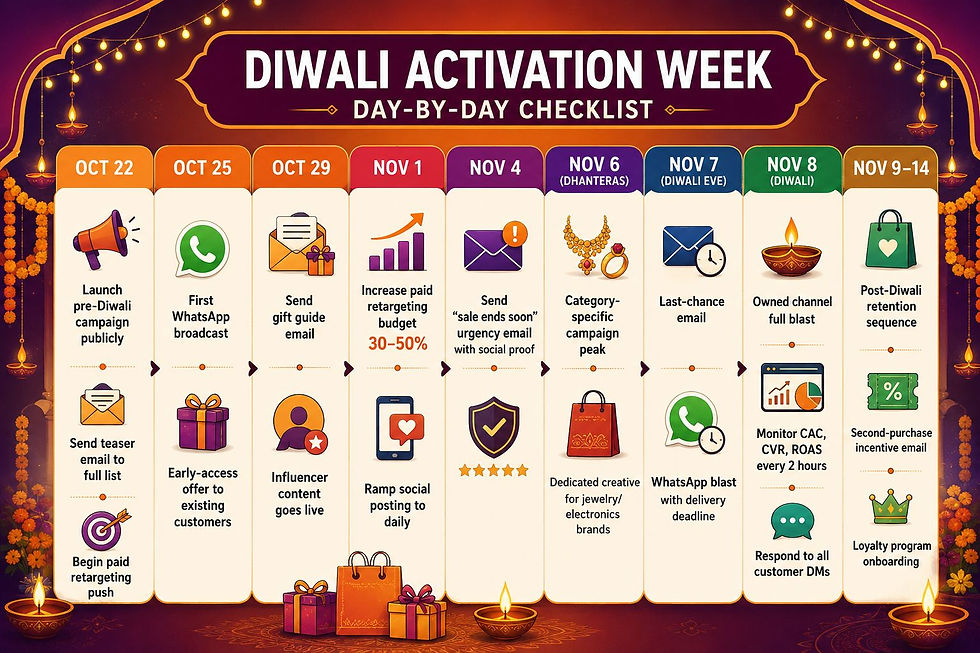
October 22: Launch pre-Diwali campaign publicly; send teaser email to full list; begin paid retargeting push
October 25: First WhatsApp broadcast to existing customers with early-access offer
October 29: Send gift guide email; influencer content goes live across partner accounts
November 1: Increase paid retargeting daily budget by 30–50%; ramp social posting to daily
November 4: Send "sale ends soon" urgency email with social proof
November 6 (Dhanteras): Category-specific campaign peak; dedicated creative for jewelry/electronics brands
November 7 (Diwali eve): Last-chance email + WhatsApp blast with delivery deadline
November 8 (Diwali): Owned channel full blast; monitor CAC, CVR, and ROAS every 2 hours; respond to all customer DMs
November 9–14: Post-Diwali retention sequence; second-purchase incentive email; loyalty program onboarding
Phase 5: Season Close (November 27–December 31: Black Friday to New Year)
Black Friday is fully established in India. Electronics, fashion, and home categories see strong demand. Lead with price drops of 30%+ on premium items — Indian consumers have learned what Black Friday looks like, and modest discounts don't generate the expected urgency.
Christmas and New Year close the festive year. Gifting through Christmas, then party wear, beauty, and experiences in the final week of December. Year-end is your best window for loyalty program activation — offer festive-season first-time buyers an incentive to return in January, converting a seasonal customer into a year-round relationship.
How to Prepare Your Website for Festive Season Traffic
Your website is the destination for every rupee of paid and organic traffic you generate. If it underperforms during peak traffic, your marketing investment leaks out at the bottom of the funnel.
Performance: Load Time Is Revenue
Your server needs to handle a traffic spike of 5–10x your normal baseline without slowing down. Talk to your hosting provider about load testing, auto-scaling, and dedicated capacity before September. A 1-second delay in page load time reduces conversion rate by approximately 7% — during Diwali week at high traffic volumes, that is a material revenue figure.
Fix: image compression, lazy loading, unused JavaScript removal, and mobile page speed specifically. Run Google PageSpeed Insights on your key landing pages and fix anything below 70.
Mobile-First Is Non-Negotiable
85% of festive traffic in India is on mobile (eShipz, 2025). Your mobile experience is the primary experience. Review your entire purchase funnel on a mid-range Android phone — not just an iPhone — before September. Common conversion killers on mobile: small tap targets, slow-loading image carousels, checkout forms that don't work well with autofill, and payment screens that time out on 4G connections.
Festive Visual Identity
Your homepage and key landing pages should telegraph the season. Add a festive banner with a clear, specific offer statement. Update your hero image to festive lifestyle photography. Add countdown timers to sale end dates during active promotions. The visual context primes the buying mindset before the customer even reads your offer.
Make Gifting Frictionless
Add a dedicated gifting section to your navigation during the festive season. Inside it: curated gift sets organized by occasion and price range, a gift guide with clear recipient tagging, a gift message option at checkout, and premium gift packaging as a selectable add-on. The customer buying for someone else has less clarity on what to choose and more anxiety about delivery timing — reduce both friction points explicitly.
Trust Signals for First-Time Visitors
A significant portion of festive traffic is first-time visitors who don't know your brand. Display customer reviews prominently on product pages. Show your return and exchange policy clearly on every product page. Display a delivery estimate near the Add to Cart button. These signals are table stakes for marketplace-trained consumers who are giving your D2C site a chance.
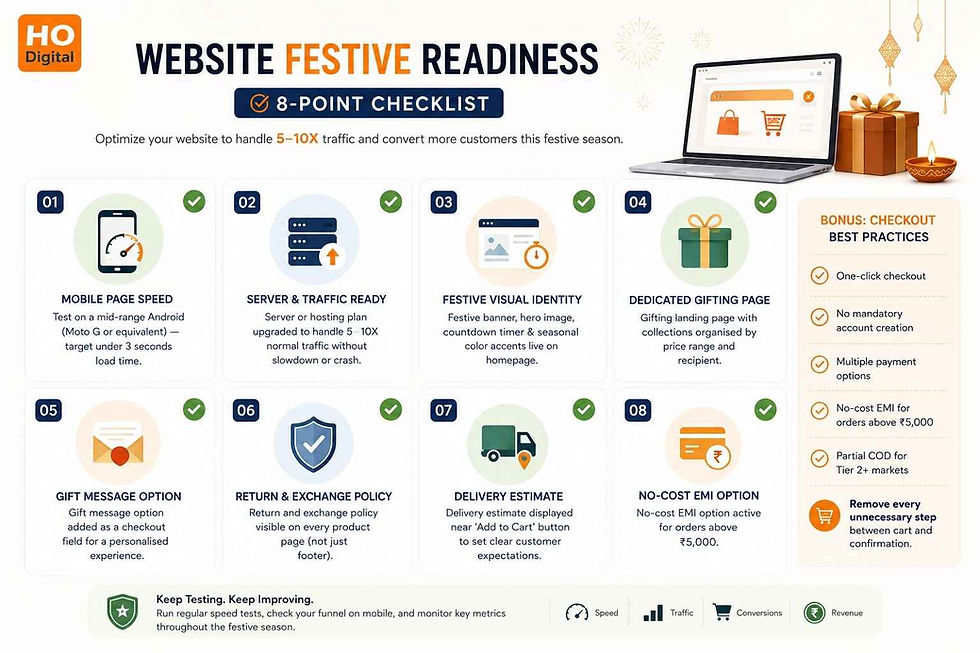
Website Festive Readiness: 8-Point Checklist
Mobile page speed tested on a mid-range Android device (Moto G or equivalent) — target under 3 seconds load time
Server or hosting plan upgraded to handle 5–10x normal traffic without slowdown or crash
Festive visual identity live on homepage: banner, hero image, countdown timer, seasonal color accents
Dedicated gifting landing page with collections organised by price range and recipient
Gift message option added as a checkout field
Return and exchange policy visible on every product page (not just footer)
Delivery estimate displayed near Add to Cart button
No-cost EMI option active for orders above ₹5,000
Checkout: Remove Every Unnecessary Step
One-click checkout, no mandatory account creation, and multiple payment options are baseline requirements. Add no-cost EMI for orders above ₹5,000 — for high-ticket purchases, splitting into 3 or 6 monthly payments measurably improves conversion. Offer partial COD where feasible for Tier 2+ markets. Every unnecessary step between cart and confirmation is revenue leaving your store.
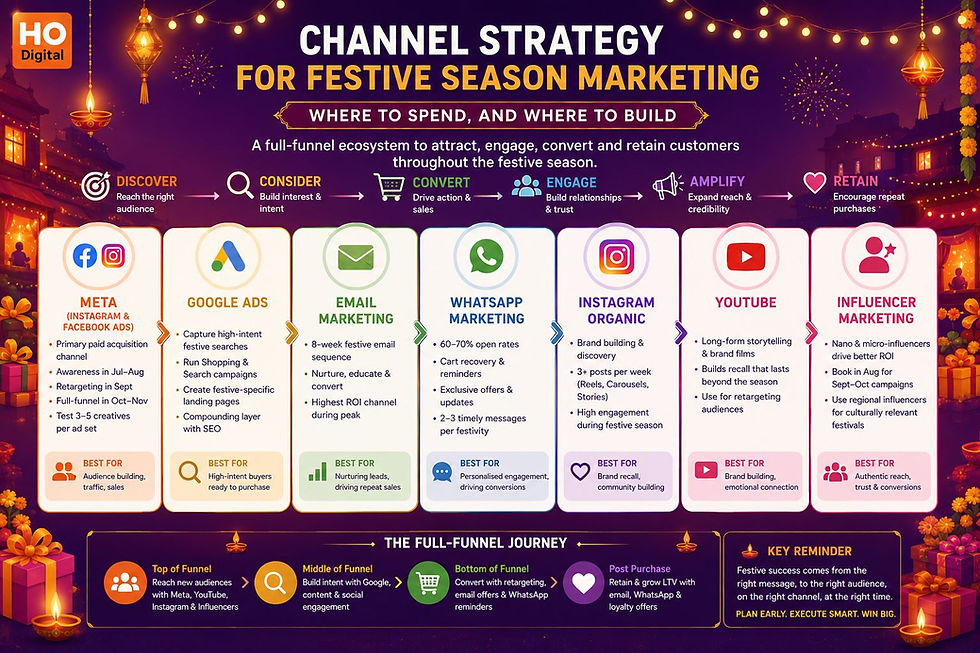
Channel Strategy for Festive Season Marketing: Where to Spend, and Where to Build
Meta (Instagram and Facebook Ads)
Your primary paid acquisition channel. The strategic arc across the season:
July–August: Awareness campaigns. Low CPMs, pure audience building. Video views, reach, engagement objectives.
September: Warm-up retargeting. Target site visitors and social engagers from the past 60 days.
October–November: Full-funnel activation. Top of funnel: broad lookalikes of best customers. Middle funnel: website visitors, email list custom audiences. Bottom funnel: cart abandoners and product page visitors.
For ad creative during peak, UGC-style content consistently outperforms polished brand shoots in-feed because it doesn't look like an ad. This isn't festive-specific — it's the same principle behind writing hooks that actually convert, just amplified by how crowded the feed gets in October.
Test 3–5 creative variations per ad set before scaling. Let the algorithm surface winners before you put significant budget behind them.
Google Ads
Festival-specific search keywords spike dramatically in September–November. "Diwali gifts for wife," "ethnic wear for Navratri," "best Dhanteras offers on electronics" — these are high-intent searches from buyers who are ready to purchase. If you're not capturing this intent with Shopping campaigns and branded search, competitors are intercepting customers who were looking for you.
Build keyword research specifically for festive terms in your category in August. Create dedicated landing pages for top festive search terms — a generic homepage doesn't convert search traffic as well as a page that speaks directly to the search intent.
Everything in this section is paid. Capturing festive search demand organically — so 'best Diwali gifts for wife' finds you in the years you're not running Shopping campaigns too — is the compounding layer most D2C brands skip
Email Marketing Campaign
Your most reliable, highest-ROI channel during peak. The festive email sequence that consistently performs:
8 weeks before Diwali: Announce the season is coming. Tease the collection. Offer early access signup.
4 weeks before: Collection launch. Focus on newness, not discount. Introduce the gifting range.
2 weeks before: Gift guide email. Curated selections by price range and recipient.
1 week before: Sale launch with primary offer. Clear CTA, single focus.
3 days before Diwali: Reminder with social proof. Urgency through real demand signals.
Diwali day: Final push. Last-chance language. Free delivery deadline if applicable.
Post-Diwali days 2–5: Continuation or gift-yourself angle. Keep the sale window open for late deciders.
Post-Diwali week 2: Thank-you email to purchasers and cross-sell. Loyalty incentive for second purchase.
Subject lines should be specific. "Your Diwali gifting guide is here" outperforms generic festive subject lines in nearly every A/B test we run.
India's most personal digital channel. Open rates run 60–70%, dwarfing email in most categories. Use it for: cart abandonment follow-ups (24 hours after abandonment), exclusive early-access offers to existing customers, last-day sale reminders, order confirmations and shipping updates, and gifting deadline urgency messaging.
WhatsApp is a trust-dense channel — daily broadcast messages during festive week will spike unsubscribes. 2–3 well-timed, well-personalized messages per festival window is the right frequency.
Instagram Organic
Your brand-building and discovery channel. During festive season, high-performing organic content gets algorithm amplification because engagement rates spike across the platform. Plan at minimum 3 posts per week from September through November, across Reels, carousels, and Stories.
YouTube
Long-form brand storytelling. Festive campaigns on YouTube — emotional ads, founder stories, behind-the-scenes — build the brand recall that paid social can't fully replicate. A 60–90 second festive brand film published in October continues earning views long after the season ends. It also feeds your YouTube retargeting audiences for subsequent paid campaigns.
Influencer Marketing
The festive season is influencer season. Nano and micro-influencers (10K–100K followers) in your category typically deliver better ROI than celebrity partnerships for D2C brands — their audiences trust them more and the content reads as authentic. Book influencers in August for September–October campaigns.
Regional influencers are significantly underutilized. A Tamil Nadu-based influencer with 50K followers activated for Onam, or a Maharashtra creator for Ganesh Chaturthi, will convert better than a national influencer with 500K followers but no contextual relevance. Culturally specific content earns the right to be part of the festival.
Instagram Content Plan for Festival Season: What to Post and When
Instagram is where D2C brand perception is built and purchase intent is created. Here's the complete content strategy.
The Four Content Pillars
Pillar 1: Product Storytelling (40% of content)
Not product shots. Stories about products. The artisan who made it, the material sourced for the festive collection, the design decision behind the Diwali range, the problem it solves for someone shopping for a gift. Show the product in use — in a home decorated for Diwali, on a person dressed for Navratri, in a gifting unboxing. Emotional context drives both engagement and conversion in ways a white-background product photo never will.
Best formats: Reels (15–30 seconds showing the product in real-world use), carousels (multiple angles with a storytelling caption), Stories (quick product highlight with a link to shop).
Pillar 2: Gifting Guides and Inspiration (25% of content)
These generate your highest save rates. "5 Diwali gifts under ₹1000," "What to gift your sister on Raksha Bandhan," "Home decor gifts she'll actually love" — content that helps people make a decision they're already trying to make. Carousels perform best here (each slide = one gifting idea with price and tag). The editorial feel makes it feel less like an ad, which means it gets shared and saved more. There's a newer version of this same discovery moment worth building for: showing up when shoppers ask ChatGPT for gift ideas directly, not just scrolling Instagram for inspiration.
Pillar 3: Cultural Connection (20% of content)
Content that earns the right to be part of the festival rather than just selling during it. Festive traditions explained, how different regions celebrate the same festival differently, the meaning behind rituals your products are part of. This content builds brand credibility and drives shares — the highest-value engagement signal on the platform.
Authenticity matters more than production value here. A founder talking genuinely about what Diwali means to their family and their brand will outperform a polished agency-produced post.
Pillar 4: Community and UGC (15% of content)
Repost customer photos with permission. Run a branded hashtag campaign that encourages customers to share their purchases. UGC provides free content, creates social proof for prospective buyers, and makes existing customers feel visible — three outcomes from a single post.
Reels Ideas That Consistently Perform During Festive Season
"5 Diwali looks under ₹2000" — quick styling montage for fashion brands
"How we make our Diwali collection" — behind-the-scenes production for any category
"Diwali gift unboxing" — packaging reveal, the moment of opening
"What ₹500 to ₹5000 gets you as a Diwali gift" — tiered gifting guide in video
Before and after home transformation using your products for home decor brands
Founder to camera: the story behind the festive collection
"Get ready with me for Navratri and Diwali" featuring your products in the routine
Customer reaction videos to receiving your gift packaging
Packaging process video — high watch-time format
"3 things I wish I knew before Diwali shopping" — hook-driven educational content
Post Reels at minimum 3x per week during October and November. Each well-performing Reel builds algorithm momentum for the next one. Accounts that go from 2 posts per week to daily posting during festive season see compounding reach benefits.
Weekly Instagram Content Calendar Template for Festive Season
Monday: Product storytelling Reel — 15 to 30 seconds showing the product being used in a festive setting
Tuesday: Stories — flash sale countdown, poll ("which gift would you pick?"), or swipe-up to shop
Wednesday: Gifting guide carousel — 5 to 7 slides, each slide one gift idea with price tag and product link
Thursday: UGC repost or customer review highlight with the buyer's permission
Friday: Cultural connection post — festival tradition, meaning behind a ritual, or regional celebration story
Saturday: Behind-the-scenes Stories — packaging process, warehouse preparation, or team getting ready for the season
Sunday: Community content — contest entry reminder, branded hashtag showcase, or response to top comments
Insta Stories Share Strategy
Stories are where you convert consideration into purchase. Use them for: flash sale countdowns, last X units left inventory urgency, poll stickers, swipe-up links to specific festive collections, sharing customer DMs and reviews in real time, and behind-the-scenes on Diwali day itself.
5–7 Stories per day during peak festive weeks. They decay in 24 hours but are your most direct path to the shop link conversion moment.
Paid Amplification of Organic Content
Your best-performing organic posts — high saves, shares, and comments — should be boosted with paid spend. The algorithm has already told you what resonates with your organic audience. Paid promotion amplifies that signal to lookalike audiences at higher efficiency than starting a paid creative from scratch.
Where D2C Founders Should Focus During Festival Season to Boost their Sales
Founders get pulled in every direction during the festive season — operations, customer issues, team management, cash flow. Here is where your attention creates leverage that no one else on your team can replicate.
June–September: Make the Big Decisions
This is when the founder's job is to make decisions that can't be delegated. Which festivals are you treating as major revenue windows? What's your gifting strategy? What's your inventory position? What's the promotional depth — where will you discount, by how much, and what's your margin floor?
The CPM problem is mostly a planning problem. Founders who ask "why is my festive CAC so high?" in November often failed to ask "what am I doing in August to make October cheaper?" in June. Lock your festive calendar, approve your creative direction, and set your owned-channel growth targets in June. Then let the team execute.
October–November: Customer Experience and Real-Time Decisions
Two things only the founder does well during peak: make fast decisions when things go wrong — inventory stockouts, logistics delays, website issues — and show up authentically for the brand on its own channels.
Founders who post personally during Diwali — behind-the-scenes, personal messages, genuine responses to customer DMs — generate engagement no paid campaign can replicate. Your customers want to know there's a real human behind the brand. During the most emotionally charged shopping period of the year, that human connection converts.
Watch your metrics daily during peak week. CAC by channel, conversion rate, AOV, cart abandonment rate, return rate. Fast decisions on underperforming ad sets and overperforming products can move the final revenue number meaningfully.
November–December: Retention and Learning
The festive season hands you your largest new customer acquisition of the year. What you do with those customers in the 60 days after Diwali determines whether they're one-time buyers or lifetime ones.
Personal priority: build a post-season retention sequence before the festive season starts, not after. Thank-you emails, product education content, a second-purchase incentive, a loyalty program onboarding flow — these should be ready to deploy the moment the sale window closes.
The other post-season priority is an honest debrief. What did you spend by channel? What did it generate? What was your real CAC and ROAS? Which creatives worked? Which offers drove AOV versus just volume? Which festivals punched above their weight? This analysis, done rigorously in November, is the foundation of a smarter festive plan next year.
The Pre-Season Marketing Checklist for D2C Brand Owner (Complete This by August)
Use this as your August review against the season ahead.
Strategy
Festive calendar finalized — which festivals, what budget allocation, what promotional depth
Gifting strategy defined — collections, bundles, gift sets, packaging
Margin floors set for each promotional window
Infrastructure
Inventory plan locked for all festive SKUs, including gift sets
Creative assets produced — photography, video, Reels content ready to publish from September
Website mobile performance tested on mid-range Android
Server/hosting scaled for 5–10x normal traffic
Payment options confirmed: EMI, BNPL, UPI, COD options
Owned Channels
Email list growth campaign running — capturing subscribers before CPMs rise
WhatsApp broadcast list building in progress
Post-festive retention email sequence designed and ready to deploy
Paid Channels
Facebook and Instagram pixels firing on all key pages
Custom audiences set up: site visitors (30/60/90 days), video viewers, email list custom audience
Lookalike audiences created from best customers
Google Shopping campaigns live for festive keywords
Influencers booked for October–November campaigns
Analytics
Festive analytics dashboard set up — CAC by channel, ROAS, AOV, conversion rate, cart abandonment
Post-season debrief template prepared
How a Performance Marketing Agency Runs Festival Season Marketing for D2C Brands
Running all of this in parallel is the actual challenge. Most D2C brands we speak to are strong on one or two dimensions — great at Meta creatives, but haven't built their email list; excellent on Instagram, but not running retargeting campaigns; doing Diwali well, but missing Raksha Bandhan and Onam.
A performance marketing agency's value during festive season is the ability to run the full funnel simultaneously: building audiences in August, activating them in October, running email and paid together with consistent messaging, adjusting creative and spend in real time during peak week, and setting up retention infrastructure that extends the value of festive acquisition beyond the season itself.
The brands that consistently outperform don't just spend more during the festive season — they start earlier, build more deliberately, and execute across every channel in a coordinated way. That's the discipline that turns festive season from a high-cost sprint into a compounding brand-building and revenue event.
Frequently Asked Questions About Festival Season Marketing in India
When should D2C brands start festive season marketing?
Ans: The practical answer is August for audience building, September for campaign activation, and October for peak execution. Brands that wait until October find themselves in an expensive CPM environment with no warm audiences to retarget. Pre-season awareness investment in July–August is the highest-leverage, lowest-cost preparation you can make.
Which festivals drive the highest ecommerce GMV in India?
Ans: Diwali, including the surrounding windows of Dhanteras and Navratri, accounts for the single largest festive commerce peak. The 30–35 day pre-Diwali window generates more ecommerce GMV than any other period. Raksha Bandhan and Holi are the next most significant for specific categories. Republic Day and Independence Day function as general sale events rather than category-specific intent drivers.
Should D2C brands discount during every festival?
Ans: No. Brands that discount during every festival train customers to wait for the next sale, which compresses margins year-round. Reserve deep discounting for windows where purchase intent is already strong and you need to convert undecided shoppers: Dhanteras, Diwali day, and Black Friday. For other festivals, lead with gifting collections, curated bundles, and emotional campaigns that convert without conditioning customers to hold out for a deal.
How do you reduce CAC during the festive season when CPMs are high?
Ans: The answer is pre-season investment. Warm audiences, owned channels (email, WhatsApp), and retargeting lists built before September are the primary tools. During peak, allocate paid spend preferentially toward retargeting warm audiences rather than broad cold acquisition. This is the structural difference between brands with 1.5x normal CAC during Diwali and brands with 3x normal CAC.
What makes festive Instagram content work in India?
Ans: Cultural relevance, emotional authenticity, and product in context. Content that earns the right to be part of the festival — not just selling during it — consistently earns better organic reach and saves. Reels remain the highest-reach format. Gifting guide carousels generate the highest saves. Stories are the highest-conversion format for driving clicks to shop. Run all three throughout the season.
How much should a D2C brand budget for festive season marketing?
Ans: D2C brands typically allocate 15-20% of annual marketing budget to the festive season (August–December), with 60-70% going to paid acquisition and the remainder split across content production, influencer partnerships, and owned-channel infrastructure like email and WhatsApp tooling.
This playbook is based on our experience running performance marketing for D2C brands across the Indian festive calendar. We'd be glad to help in planning your festive season marketing strategy and want to talk through your specific requirements — channels, budget allocation, creative approach, or owned channel infrastructure — we'd be glad to help.


